

Ever notice how some people bounce back from failure like it’s nothing, while others shut down after one mistake? It’s not about talent. It’s not about luck. It’s about growth mindset. This isn’t some fluffy self-help idea-it’s a proven way your brain learns, adapts, and improves over time. And the good news? You can build it, no matter where you start.
What a growth mindset actually means
A growth mindset is the belief that your abilities can improve with effort. It’s the opposite of a fixed mindset, where you think your intelligence, talent, or skills are set in stone. If you’ve ever said, "I’m just not good at this," or "I’m not a math person," you’re operating from a fixed mindset. That voice isn’t telling you the truth-it’s just a habit.
Psychologist Carol Dweck spent decades studying this. She found that students with a growth mindset didn’t just do better in school-they actually enjoyed challenges more. They didn’t fear mistakes. They saw them as clues. Companies like Microsoft and Google now train teams in growth mindset principles because it directly impacts innovation and resilience.
How your brain changes when you shift your mindset
Your brain isn’t a static machine. It’s a living network of connections called neurons. Every time you learn something new-even if you mess up-you strengthen those connections. This is called neuroplasticity. When you believe you can get better, your brain responds by working harder. You pay more attention. You try different strategies. You stick with it longer.
That’s not magic. It’s biology. People with a fixed mindset, on the other hand, avoid effort because they think it proves they’re not smart. They see hard work as a sign of weakness. But here’s the twist: the people who get really good at something didn’t start out good. They just kept going.
Step 1: Catch your fixed mindset voice
The first step to changing your mindset is noticing when it’s talking. That little voice inside your head that says:
- "I’ll never be able to do this."
- "They’re just naturally better than me."
- "If I fail, I’m a failure."
These aren’t facts. They’re assumptions. Start writing them down. Keep a small notebook or a note on your phone. When you catch yourself thinking one of these, pause. Say out loud: "That’s my fixed mindset talking."
It sounds silly, but naming it weakens its power. You’re no longer believing it-you’re observing it.
Step 2: Reframe failure as feedback
Think about learning to ride a bike. You didn’t get it on the first try. You wobbled. You fell. Maybe you scraped your knee. Did you give up? Probably not. Why? Because you knew falling was part of learning.
But somewhere along the way, we start treating adult failures like disasters. A bad review at work? A rejected pitch? A failed exam? We think it defines us.
Try this instead: every time something goes wrong, ask: "What did this teach me?" Write down one thing-even if it’s small. "I learned I need to practice more before presenting." "I saw that I panic under pressure, so I need to rehearse with someone watching."
Failure stops being a verdict. It becomes data.
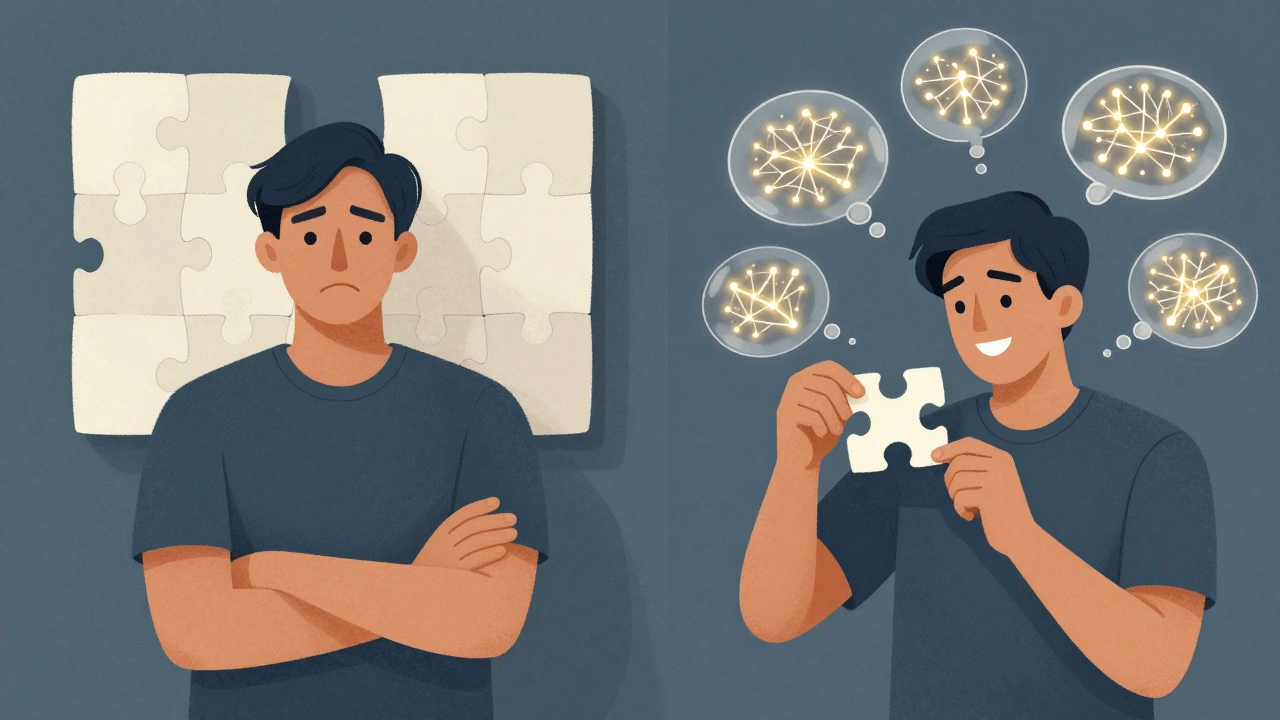
Step 3: Swap "I can’t" for "I can’t yet"
This one simple word changes everything. "I can’t do public speaking" becomes "I can’t do public speaking yet." That tiny addition opens the door to possibility. It doesn’t promise instant success. It just says progress is possible.
Try it for a week. Every time you catch yourself saying "I can’t," add "yet." Notice how your body feels. Do you feel more open? Less trapped? That’s your brain starting to rewire.
Even professional athletes use this. Serena Williams didn’t say, "I can’t lose this match." She said, "I haven’t won this match yet." The difference? One keeps you stuck. The other keeps you moving.
Step 4: Celebrate effort, not just results
We’re trained to reward outcomes. Good grades. Big promotions. Perfect presentations. But real growth happens in the messy middle-the days you show up when you don’t feel like it, when you’re tired, when you’re scared.
Start tracking effort. At the end of each day, write down one thing you tried even if it didn’t work. "I asked a question in the meeting even though I was nervous." "I spent 20 minutes learning Python even though I got frustrated."
Over time, you’ll start to value the process more than the outcome. And that’s when real change takes root.
Step 5: Surround yourself with growth-minded people
People influence you more than you think. If you’re always around people who complain about how hard things are, or who say "That’s just not for people like us," you’ll start believing it too.
Look for people who ask questions instead of giving excuses. Who say "How can I improve?" instead of "Why does this always happen to me?" Read books or listen to podcasts by people who talk about learning, not just winning. Join online communities where people share their struggles openly.
You don’t need to cut out everyone who has a fixed mindset. But you do need to protect your own thinking. Spend more time with those who make you feel capable, not small.
Step 6: Use challenges as your training ground
Growth doesn’t happen in comfort zones. It happens when you stretch. So stop avoiding hard things. Start choosing them.
Take on a project that scares you. Learn a skill you think you’re "not good at." Volunteer for something outside your usual role. Say yes to feedback-even if it hurts.
Here’s a simple rule: if something makes you feel uncomfortable, and you’re not terrified, it’s probably the right kind of challenge. If you’re terrified, break it into smaller steps. But don’t run from it.
Every time you face something hard and stick with it, you’re building mental muscle. Just like lifting weights, it gets easier over time.

What doesn’t work
Some people think buying a journal or repeating affirmations like "I am capable" will fix everything. That’s not enough. Growth mindset isn’t about positive thinking-it’s about positive doing.
Also, don’t wait for motivation. Motivation follows action. You don’t need to feel ready. You just need to start. Even five minutes counts.
And don’t compare your progress to someone else’s highlight reel. Everyone’s journey is different. Your growth isn’t measured against others. It’s measured against your own past self.
Real-life example: Sarah’s story
Sarah was a project manager who hated public speaking. She’d avoid meetings where she had to present. She told herself she was just "bad with words." Then her company asked her to lead a client workshop. She panicked.
Instead of saying no, she did three things:
- She wrote down every time she thought "I can’t do this" and replaced it with "I can’t do this yet."
- She practiced for 15 minutes every morning with her dog as the audience.
- After the workshop, she asked for honest feedback-not praise, just what she could improve.
She didn’t become a TED speaker overnight. But she didn’t quit either. Six months later, she led three more workshops. She still gets nervous. But now she says, "Nervous means I care. And I’m getting better."
How long does it take to build a growth mindset?
There’s no magic timeline. Some people notice shifts in a few weeks. Others take months. It depends on how long you’ve held onto fixed beliefs. But you don’t need to wait for "perfect" to start.
Start small. Pick one step from above. Do it for 21 days. Notice how you think differently. Notice how you react to setbacks. That’s your growth mindset growing.
Final thought: You’re not stuck
You weren’t born with a fixed mindset. You learned it-from school, from parents, from society. And because you learned it, you can unlearn it. Every time you choose effort over ease, curiosity over judgment, persistence over perfection-you’re rewriting your brain’s programming.
It’s not about being the best. It’s about becoming better than you were yesterday. And that? That’s always within reach.
Can you have a growth mindset in some areas and a fixed mindset in others?
Yes, absolutely. Most people do. You might believe you can improve at work but think you’re just "not a math person." Or you might feel confident in relationships but freeze up when learning new tech. That’s normal. The key is noticing where your fixed mindset shows up and applying the same steps-catching the thought, reframing it, taking action-wherever it appears.
Is growth mindset just for students or young people?
No. Carol Dweck’s research includes adults, CEOs, athletes, and retirees. Neuroplasticity doesn’t stop at 25. People in their 60s and 70s have learned new languages, switched careers, and mastered instruments after adopting a growth mindset. Age doesn’t limit learning-belief does.
What if I try everything and still feel stuck?
Feeling stuck doesn’t mean you’re failing-it means you’re in the middle of the process. Growth isn’t linear. Sometimes progress feels invisible until one day you look back and realize you’ve changed. Keep doing the small things: write down effort, reframe failure, say "yet." If you’re still struggling, consider talking to a coach or therapist. Sometimes old beliefs are tied to deeper experiences that need support to unpack.
Does having a growth mindset mean I should never quit anything?
No. Growth mindset isn’t about stubborn persistence. It’s about smart persistence. If something isn’t aligned with your values, or if you’ve tried multiple approaches and still see no progress, it’s okay to walk away. The difference is why you quit. A fixed mindset quits because "I’m not good at this." A growth mindset quits because "This isn’t the right path for me right now." One is defeat. The other is direction.
Can a growth mindset help with anxiety or depression?
It can help as part of a broader approach. A growth mindset won’t cure clinical anxiety or depression, but it can reduce feelings of helplessness. When you believe change is possible, you’re more likely to seek help, stick with therapy, or try new coping strategies. It shifts you from "I’m broken" to "I’m learning how to heal." Always combine mindset work with professional support when needed.
If you’re ready to start, pick one step today. Write down one fixed mindset thought you’ve had this week. Then rewrite it with "yet." That’s your first step. No need to wait for motivation. Just begin.