
Worry Window Timer
Your Worry Window
Schedule your anxiety. Give your mind a designated time to process worries, then contain them.
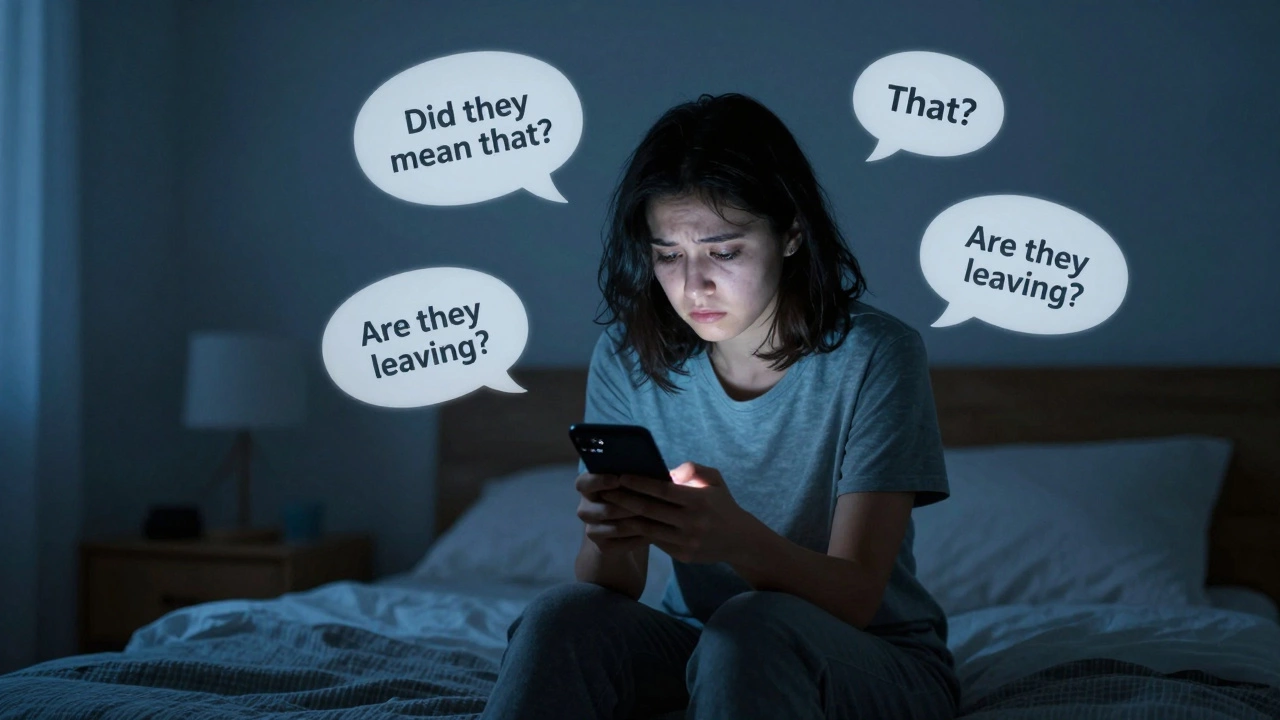
You keep replaying that text message in your head. Was it too casual? Did they mean something by the pause before they replied? You’ve gone over every word, every tone, every silence-again and again. By the time you finally fall asleep, you’re exhausted. And tomorrow, you’ll do it all over.
Overthinking relationships isn’t just annoying. It’s draining. It turns small moments into crises. It makes you doubt love that’s real. And worst of all, it pushes people away-not because you’re too much, but because you’re too loud inside your own head.
The good news? You can stop. Not with positive affirmations or vague advice like "just relax." You can stop with real, practical steps that work for real people-not theory, not Instagram quotes.
Understand why your brain does this
Your brain didn’t wake up one day and decide to ruin your love life. It’s trying to protect you.
Evolutionarily, humans were wired to spot social threats. Being rejected by the group once could mean death. So your brain became hyper-alert to signs of disapproval, distance, or abandonment-even when there’s none.
When you overthink, you’re not being dramatic. You’re stuck in survival mode. Every silence feels like a warning sign. Every delayed reply feels like a rejection. Your mind is scanning for danger, not connection.
This isn’t about being insecure. It’s about a nervous system stuck in high alert. And that’s something you can reset.
Stop checking their phone or social media
How many times have you checked their Instagram story, their last online status, or their likes from three days ago? You’re not curious-you’re searching for proof. Proof they still care. Proof they haven’t changed. Proof they’re not leaving.
Here’s what happens when you do this: you train your brain to find evidence of danger-even when it doesn’t exist. You start seeing patterns where there are none. A missed like becomes a breakup signal. A late reply becomes emotional withdrawal.
Try this: put their phone out of reach for 24 hours. Not to punish them. Not to test them. Just to give your brain a break.
When you stop checking, you stop feeding the cycle. You give space for trust to grow-not because you’re ignoring the problem, but because you’re choosing to believe in what’s real, not what your anxiety imagines.
Write it out-but only once
When your mind won’t shut up, write it down. Not in a journal. Not as a letter you’ll never send. Write it like you’re dumping garbage into a bin.
Grab a notebook. Write everything: "They didn’t text back. They’re mad. They’re thinking of leaving. I’m not enough. I always mess this up. They’ll find someone better. I’ll be alone forever."
Now, read it. Then, tear it up. Burn it. Throw it away.
This isn’t therapy. It’s a reset button. Your brain keeps looping the same fears because they’re unprocessed. Writing them out gives them a physical form-and then destroying them tells your brain: "I don’t need to hold onto this anymore."
Do this once a day for a week. You’ll notice the thoughts lose their power. They’ll still come, but they won’t feel like truths. They’ll feel like noise.

Set a 10-minute worry window
Here’s a trick used by therapists and people who’ve actually stopped overthinking: schedule your anxiety.
Every day, pick a 10-minute block-say, 6:30 p.m. Set a timer. When thoughts start swirling, tell yourself: "I’ll deal with this at 6:30."
When the timer goes off, sit down. Let yourself think everything you’ve been holding back. Write it. Cry if you need to. Say it out loud.
When the timer ends, stop. No more.
This works because your brain hates structure. It thrives on chaos. Give it a box, and it stops trying to break out. You’re not suppressing your feelings-you’re containing them. And that’s the first step to controlling them.
Ask yourself: Is this about them-or me?
Here’s the quiet truth: most of what you’re overthinking isn’t about your partner. It’s about your past.
Did someone leave you before? Did you feel ignored as a kid? Were you taught that love is conditional? Those wounds don’t vanish just because you’re in a new relationship.
When you catch yourself thinking, "They’re pulling away," pause. Ask: "Is this happening now-or did it happen before?"
That’s the difference between reality and memory. Your partner might be quiet because they’re tired. But your brain says: "They’re done with you."
Write down the thought. Then write the truth: "I feel scared because I was left before. But they haven’t left. They’re here."
That simple shift-separating past pain from present reality-breaks the cycle faster than any technique.
Replace "What if?" with "What is?"
Overthinking is future-tripping. You’re not thinking about today. You’re imagining worst-case scenarios that might never happen.
What if they don’t call? What if they say they need space? What if they meet someone else?
Each of those questions is a trap. They don’t lead to answers. They lead to panic.
Instead, ask: "What is true right now?"
Right now, they’re breathing. Right now, they’re sitting on the couch. Right now, they sent you a meme this morning. Right now, you’re alive. Right now, you’re safe.
Ground yourself in the facts. Not the fears. Not the stories. The actual, physical, measurable reality.
When you do this, your body calms down. Your heart rate drops. Your shoulders relax. Your mind stops spinning.

Build your own stability
The biggest reason you overthink relationships? You’re looking outside yourself for safety.
You think: "If they love me, I’ll be okay." But love isn’t a shield. It’s a mirror. And if you’re shaky inside, every reflection looks broken.
Start building your own stability. Not to fix yourself. Not to become "enough." Just to stop needing someone else to hold you together.
Do one thing every day that makes you feel like you’re on your own team:
- Walk without your phone
- Make a meal you love
- Call a friend who doesn’t ask for anything
- Write down three things you did well today
These aren’t self-care rituals. They’re acts of self-trust. They tell your brain: "I don’t need them to validate me. I’m here. I’m safe. I’m enough."
When you build that inner foundation, relationships stop feeling like life-or-death tests. They become something you get to enjoy-not something you have to survive.
Stop waiting for reassurance
Do you ask for reassurance? "Do you still love me?" "Are you sure you’re not mad?" "Do you think we’re okay?"
Every time you ask, you’re saying: "I can’t trust myself. I need you to fix my fear."
And here’s the problem: no one can fix that for you. Not your partner. Not your therapist. Not a hundred "I love yous."
Reassurance gives you a quick fix-but it makes the craving worse. You start needing more. More texts. More calls. More proof.
Try this instead: When the urge hits, say to yourself: "I don’t need to know right now. I can sit with this feeling."
It’s uncomfortable. It feels like surrender. But it’s actually power. You’re choosing to trust yourself, even when you’re scared.
That’s the moment your relationship changes-not because they changed, but because you did.
Progress isn’t linear
You’ll have days where you’re calm. Days where you feel fine. And then-out of nowhere-you’ll spiral again. A text takes too long. A tone sounds off. You’re back to square one.
That’s normal.
Healing isn’t about never feeling anxious again. It’s about knowing how to come back.
When you slip, don’t shame yourself. Don’t say, "I’m broken." Say, "I’m learning."
Every time you catch yourself overthinking and choose to pause, breathe, and ground yourself-you’re rewiring your brain. You’re teaching it that love isn’t a threat. That you’re safe. That you don’t need to fight for connection.
It’s not about perfection. It’s about practice.
You’re not failing. You’re becoming.