

Mindset Assessment Tool
Mindset Check: How Do You React?
Answer honestly to see where your natural instincts lie.
We will present you with 5 common life scenarios. Choose the reaction that feels most natural to you in the moment.
Loading...
Have you ever noticed that some people seem to bounce back from failure while others crumble? Or why one person sees a mistake as a learning opportunity, while another sees it as proof they aren't good enough? The difference often isn't talent or luck. It's mindset. But how do you actually know which one you have? Identifying your mindset is the first step toward changing it if it’s holding you back.
Most of us walk around with a mix of attitudes and beliefs that we don’t even realize are steering our lives. We call these mental frameworks “mindsets.” They act like invisible software running in the background of your brain, processing every challenge, compliment, and setback. If you want to improve your career, relationships, or personal happiness, you need to debug this software. Let’s look at how to spot the signs of your current mindset so you can take control.
Understanding the Core Mindset Types
To identify your mindset, you first need to know what you’re looking for. Psychologist Carol Dweck popularized two main categories: the Fixed Mindset and the belief that abilities are static traits you are born with, and the Growth Mindset and the belief that abilities can be developed through dedication and hard work.
A fixed mindset assumes that intelligence, talent, and personality are carved in stone. If you believe you’re just “not a math person” or “not creative,” you’re operating from a fixed perspective. This view makes effort feel pointless because if you have to try hard, it means you’re not naturally gifted.
In contrast, a growth mindset views challenges as opportunities to expand your capabilities. People with this outlook understand that neural pathways strengthen with practice. They see effort as the path to mastery, not a sign of weakness. Recognizing which of these lenses you’re currently using is crucial for accurate self-assessment.
Signs You Have a Fixed Mindset
Identifying a fixed mindset involves observing your automatic reactions to stress and feedback. These patterns often show up in subtle ways during daily interactions. Here are common indicators:
- Avoidance of Challenges: You stick to tasks you already know you can do. Trying something new feels risky because failure would prove you’re inadequate.
- Fear of Feedback: Criticism feels like a personal attack rather than useful data. You might get defensive or dismissive when someone points out an error.
- Jealousy of Others’ Success: When someone else succeeds, you feel threatened or diminished. Their win feels like your loss.
- Giving Up Easily: When progress slows down or becomes difficult, you quit. You interpret difficulty as a signal that you’ve hit your natural limit.
- Belief in Talent Over Effort: You admire people who succeed without apparent struggle and doubt those who have to work hard.
If several of these resonate, you likely lean toward a fixed mindset. This doesn’t mean you’re stuck forever; it just means your current default setting prioritizes looking smart over getting smarter.
Signs You Have a Growth Mindset
On the flip side, a growth mindset manifests as resilience and curiosity. People with this orientation are comfortable being beginners. They value the process of learning more than immediate perfection. Look for these behaviors in yourself:
- Embracing Challenges: You seek out problems that stretch your limits. You get excited by the prospect of leveling up your skills.
- Persistence in Setbacks: Obstacles motivate you to try different strategies. You view failure as temporary and informative.
- Learning from Criticism: You ask clarifying questions when receiving feedback. You use it to adjust your approach.
- Inspiration from Others: You study successful people to learn their methods. Their success sparks ideas for your own journey.
- Valuing Effort: You respect the grind. You know that expertise comes from consistent practice, not innate genius.
Notice that having a growth mindset doesn’t mean you never feel fear or frustration. It means you acknowledge those feelings but choose to move forward anyway. It’s about response, not absence of emotion.
The Role of Self-Talk in Mindset Identification
Your inner dialogue is perhaps the most reliable indicator of your mindset. Pay attention to the words you use when describing yourself and your experiences. Language shapes reality. If you constantly say, “I’m bad at this,” your brain starts to treat it as a fact.
People with a fixed mindset often use absolute language: “I always mess up,” “I’m just not smart,” or “This is impossible.” These statements close doors before you’ve even tried to open them. They create a self-fulfilling prophecy where lack of effort confirms the initial belief of inadequacy.
Conversely, growth-oriented self-talk includes qualifiers and possibilities: “I haven’t mastered this yet,” “I can learn this with time,” or “What strategy can I try next?” The word “yet” is particularly powerful. It implies that the current state is temporary and changeable. Monitoring your internal narrative helps you catch fixed-mindset triggers early.
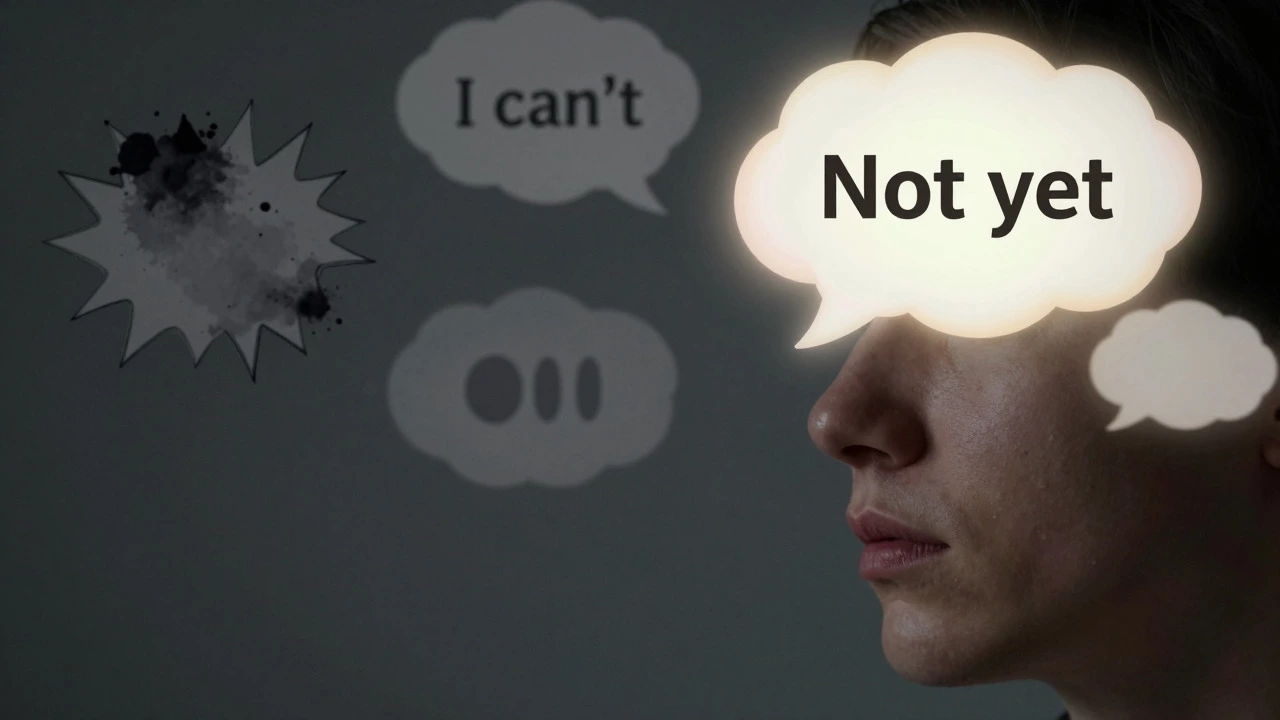
How Reactions to Failure Reveal Your Mindset
Failure is the ultimate litmus test for mindset identification. How you respond when things go wrong tells you everything you need to know. In a fixed mindset, failure defines you. It’s evidence that you lack the inherent quality needed for success. This leads to shame, avoidance, and blame-shifting.
In a growth mindset, failure informs you. It’s data. It shows you what didn’t work so you can adjust. Instead of asking, “Am I stupid?” you ask, “What did I miss?” This shift from identity-based judgment to process-based analysis is key. Next time you make a mistake, pause and observe your immediate emotional reaction. Do you want to hide, or do you want to fix?
Mindset Is Not All-or-Nothing
One common misconception is that you must be either entirely fixed or entirely growth-minded. In reality, most people operate on a spectrum. You might have a growth mindset in your career but a fixed mindset in your fitness routine. Or you could be flexible with social skills but rigid about artistic ability.
This nuance is important for accurate identification. Don’t label yourself globally. Instead, map your mindset across different domains. Ask yourself: Where do I thrive? Where do I shrink? Understanding these specific areas allows for targeted improvement. You don’t need to overhaul your entire personality overnight. You just need to shift the lens in the areas that matter most right now.
Practical Steps to Assess Your Current Mindset
Ready to dig deeper? Try these exercises to gain clarity on your dominant mindset patterns:
- Journal Your Reactions: For one week, write down three situations where you felt challenged or criticized. Note your immediate thoughts and actions. Look for fixed vs. growth language.
- Analyze Your Goals: Are your goals performance-based (looking good) or learning-based (getting better)? Performance goals often signal a fixed mindset.
- Observe Your Comfort Zone: How often do you voluntarily step into unfamiliar territory? If rarely, you may be protecting a fixed sense of competence.
- Check Your Response to Effort: Do you feel proud when you work hard, or embarrassed that it took so long? Pride indicates growth; embarrassment suggests fixed.
These reflections provide concrete evidence rather than vague feelings. Use them to build a personalized profile of your mental habits.

Why Identifying Your Mindset Matters
Knowing your mindset isn’t just an academic exercise. It directly impacts your potential for achievement and well-being. Research shows that students taught about growth mindset principles outperform peers who believe intelligence is fixed, even when starting scores are identical. This effect holds true in business, sports, and creative fields too.
When you identify a fixed mindset trap, you can interrupt it. You can choose to reframe a setback. You can decide to embrace effort. This agency reduces anxiety and increases motivation. You stop waiting for inspiration and start building capability. Ultimately, identifying your mindset empowers you to design a life based on development rather than limitation.
| Aspect | Fixed Mindset Reaction | Growth Mindset Reaction |
|---|---|---|
| Challenge | Avoids to prevent failure | Embraces to learn new skills |
| Obstacles | Gives up easily | Persists with new strategies |
| Effort | Sees it as fruitless if not talented | Views it as path to mastery |
| Criticism | Ignores or gets defensive | Leans in and learns |
| Others' Success | Feels threatened or envious | Feels inspired and curious |
Common Pitfalls in Self-Assessment
Be careful not to fall into the trap of “fake growth mindset.” This happens when you praise effort regardless of outcome, ignoring the need for effective strategy. True growth mindset requires honest evaluation of results. It’s not just about trying; it’s about trying *smart*. Also, avoid judging yourself harshly for having fixed thoughts. Everyone has them. The goal is awareness, not perfection. Acknowledge the thought, then choose a different response.
Another pitfall is assuming mindset is permanent. It’s not. Neuroplasticity proves our brains change throughout life. You can train yourself to think differently. Start small. Pick one area where you tend to be fixed and consciously apply growth principles there. Over time, these new neural pathways become your default.
Next Steps After Identification
Once you’ve identified your prevailing mindset, what’s next? If you’re heavily fixed, start by normalizing struggle. Remind yourself that difficulty is part of learning. Seek out mentors who model growth behaviors. Surround yourself with people who encourage experimentation. Change your environment to support your desired mental shift.
If you’re already growth-oriented, focus on sustaining momentum. Keep challenging yourself. Avoid complacency. Remember that comfort zones are where dreams go to die. Continuously scan for areas where old fixed habits might creep back in, especially under high stress.
Can you have both fixed and growth mindsets?
Yes, absolutely. Most people have a mixed mindset. You might have a growth mindset in your professional skills but a fixed mindset regarding your physical health or social interactions. It’s helpful to identify which areas trigger which mindset so you can address them specifically.
Is mindset determined by genetics?
No. While personality traits have genetic components, mindset is a learned belief system. It is shaped by upbringing, education, culture, and personal experience. Because it is learned, it can be unlearned and replaced with new beliefs through conscious effort and practice.
How long does it take to change a fixed mindset?
There is no set timeline. Changing deep-seated beliefs takes consistent repetition. Some people notice shifts in weeks, while others take months or years. The key is persistence. Every time you catch a fixed thought and reframe it, you strengthen your growth mindset muscles.
What is the biggest myth about growth mindset?
The biggest myth is that it means believing anyone can become anything with enough effort. That’s unrealistic. Growth mindset is about maximizing your potential through effort and strategy, not ignoring natural differences or limitations. It’s about progress, not perfection.
How can I help someone else develop a growth mindset?
Praise process, not just outcome. Instead of saying "You're so smart," say "I liked how you tried different methods to solve that problem." Encourage risk-taking and normalize mistakes as part of learning. Model growth behavior yourself by sharing your own struggles and how you overcame them.