

Mindset Assessment Quiz
Take the Mindset Quiz
This 5-question quiz helps you understand whether you tend toward a fixed or growth mindset. Based on Carol Dweck's research, your answers will reveal your dominant mindset style and suggest ways to cultivate a growth mindset.
This is a fixed mindset thought.
People with fixed mindsets believe their abilities are set in stone. They see challenges as proof they're not capable rather than opportunities to grow.
This is a growth mindset thought.
People with growth mindsets see challenges as part of the learning process. They believe effort leads to improvement.
This is a fixed mindset thought.
Fixed mindset people see failure as a reflection of their worth, not as information about how to improve.
This is a growth mindset thought.
People with growth mindsets view failure as data. They see it as evidence that they need to adjust their approach.
This is a fixed mindset thought.
Fixed mindset people see others' success as a reminder of their own limitations.
This is a growth mindset thought.
People with growth mindsets view others' success as inspiration and opportunity to learn new strategies.
This is a fixed mindset thought.
Fixed mindset people believe that if they don't succeed immediately, they never will.
This is a growth mindset thought.
People with growth mindsets understand that mastery takes time and practice.
This is a fixed mindset thought.
Fixed mindset people see feedback as a personal attack rather than information.
This is a growth mindset thought.
People with growth mindsets see feedback as valuable information for improvement.
Your Mindset Assessment
What This Means
How to Shift to Growth Mindset
- Notice your fixed mindset voice: When you hear "I'm not good at this," respond with "Not yet."
- Focus on effort and strategy, not just results.
- Embrace challenges as opportunities to grow.
- View feedback as valuable information, not criticism.
- Celebrate progress, not just perfection.
When you hear the word mindset, you probably think of someone who believes they can improve, or maybe someone stuck in their ways. But where did this idea actually come from? Who first put a name to the way we think about our own abilities? It wasn’t a self-help guru or a viral TikTok trend. It was a psychologist in a university lab, watching kids solve puzzles and noticing something no one had captured in words before.
The Woman Behind the Word
Carol Dweck, a professor of psychology at Stanford University, is the person who defined mindset as we know it today. In the late 1990s, she and her team began studying how children responded to failure. They noticed something strange: some kids gave up after one mistake. Others leaned in, tried harder, even smiled when the problem got tougher. Why?
Dweck didn’t just observe behavior-she dug into the beliefs behind it. She found that kids who thought intelligence was fixed-something you either had or didn’t-tended to avoid challenges. They feared looking dumb. Kids who believed intelligence could grow with effort? They saw struggle as part of learning. She called these two patterns fixed mindset and growth mindset.
Her 2006 book, Mindset: The New Psychology of Success, turned these ideas into a global conversation. But the research started decades earlier. In 1975, Dweck published a paper on learned helplessness in children. That was the seed. By the 1990s, she had enough data to say: your belief about your own ability shapes your actions more than your actual skill level.
What Mindset Actually Means
A mindset isn’t just a mood or a habit. It’s a core belief system about your abilities. Dweck’s work showed that mindset operates like software running in the background of your thoughts. It tells you whether effort is useful or pointless, whether failure is a dead end or a detour.
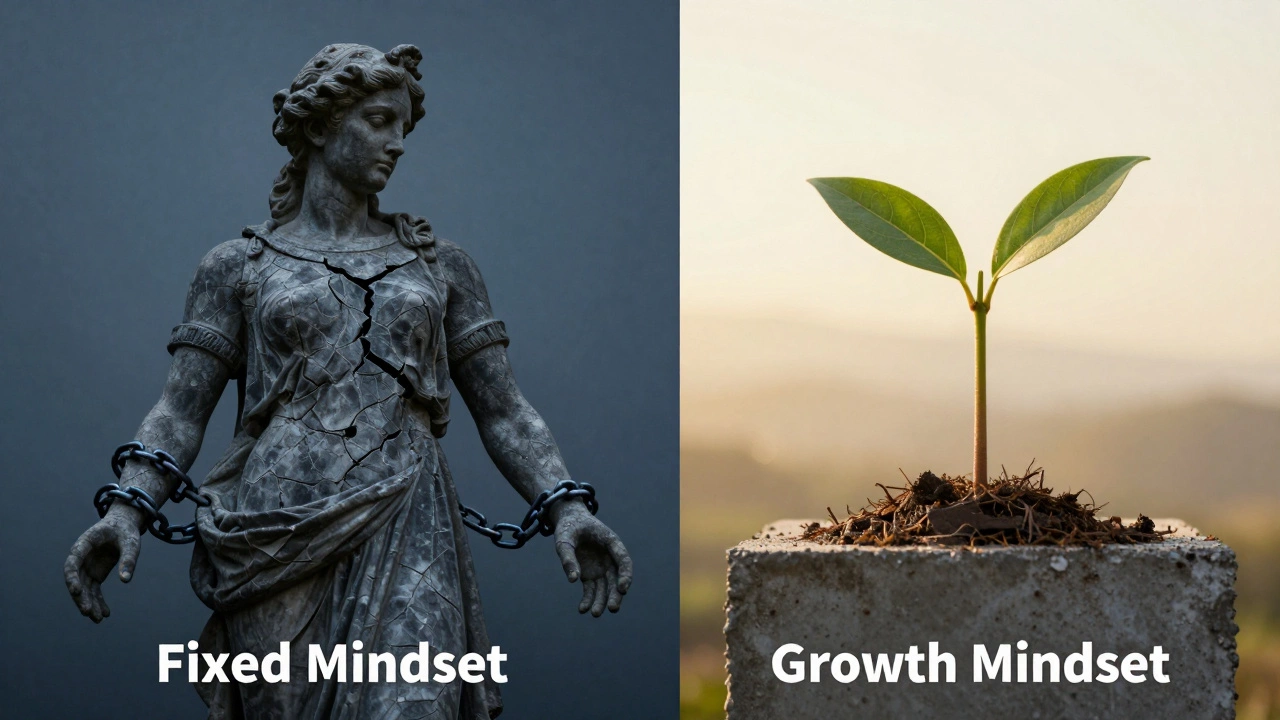
People with a fixed mindset believe:
- Your intelligence, talent, and personality are set in stone.
- If you’re not good at something right away, you never will be.
- Success means proving you’re smart or talented.
- Failure reflects your worth.
People with a growth mindset believe:
- Your abilities can be developed through hard work, good strategies, and feedback.
- Challenges help you grow, not expose your limits.
- Effort is the path to mastery.
- Feedback isn’t criticism-it’s data.
Dweck didn’t invent the idea that effort matters. Aristotle talked about habit forming character. James Clear wrote about small habits building big results. But she was the first to tie belief systems directly to performance outcomes in measurable, repeatable ways.
How Mindset Changed Education
Before Dweck, schools focused on grades, test scores, and IQ. She showed that those metrics didn’t tell the whole story. In one study, she gave students a set of hard problems. Those with a fixed mindset avoided harder questions next time. Those with a growth mindset chose harder ones-even if they got them wrong.
Teachers who learned about mindset began changing how they gave feedback. Instead of saying, “You’re so smart,” they said, “I can see how hard you worked on that.” The results? Students who were previously low-performing began closing achievement gaps. One school in Chicago saw math scores jump 15% in one year after training staff in mindset principles.
It wasn’t about motivation. It wasn’t about rewards. It was about changing the internal narrative: Can I get better at this? versus Am I good enough?
It’s Not Just for Kids
People think mindset is for classrooms. But Dweck’s research applied everywhere.
In business, leaders with a growth mindset built teams that took risks. They rewarded learning, not just results. Companies like Microsoft shifted their culture after Satya Nadella adopted growth mindset principles. He told employees: “We’re not here to prove we’re the smartest. We’re here to learn and build.” Sales teams that trained in growth mindset increased revenue by 10-15% in controlled studies.
In sports, athletes who believed talent could be developed trained longer, recovered faster from losses, and outlasted rivals who thought they were either “natural” or not. Tennis player Serena Williams didn’t say, “I was born to win.” She said, “I keep showing up because I want to get better.”
Even relationships changed. Couples who believed personality could evolve were more likely to work through conflict. Those who thought their partner’s flaws were unchangeable gave up faster.
Common Misunderstandings
People often confuse growth mindset with positivity. It’s not about telling yourself, “I can do anything!” That’s empty encouragement. Growth mindset is about believing you can improve with the right effort.
It’s not about trying harder blindly. It’s about trying smarter. If your strategy isn’t working, you change it. You ask for help. You study what worked for others. Dweck calls this “effort + strategy.”
Another myth: “I have a growth mindset.” You don’t have one mindset. You have many. You might believe you can grow as a writer but think your musical ability is fixed. Mindset is domain-specific. That’s why it’s so powerful-it’s not about being “fixed” or “growth” overall. It’s about which part of your life you believe you can change.

What Comes After the Definition?
Dweck didn’t just define mindset-she gave people a tool to change it. And that’s the real breakthrough.
You can’t just say, “I’m going to have a growth mindset.” You have to notice your fixed mindset voice. When you hear it say, “You’re not good at this,” you learn to respond: “Not yet.”
She created simple exercises:
- Write down a challenge you’re avoiding.
- Ask: “What’s my fixed mindset telling me?”
- Write a growth mindset response: “I can learn this. What’s one small step?”
- Take that step.
It’s not magic. It’s repetition. Over time, your brain rewires. The voice of doubt doesn’t disappear-it just loses its power.
Why This Matters Today
In 2026, we’re surrounded by content telling us to “believe in yourself.” But without understanding where the idea came from-and what it really means-we turn it into another slogan.
Dweck’s work is backed by over 40 years of research. It’s been tested in schools, corporations, prisons, and hospitals. It works because it’s grounded in how the brain actually learns-not in wishful thinking.
When you know who defined mindset, you know it’s not a buzzword. It’s a science. And science can be used. You don’t need to be a genius to change your mindset. You just need to start asking the right questions.
Who first defined the concept of mindset?
Psychologist Carol Dweck was the first to formally define and research mindset as two distinct belief systems: fixed and growth. Her work in the 1990s, published widely in her 2006 book Mindset: The New Psychology of Success, established the framework still used today.
Is mindset the same as attitude?
No. Attitude is how you feel about something right now-like being optimistic or grumpy. Mindset is a deeper, more stable belief about whether your abilities can change. You can have a positive attitude but still believe you’re not smart enough to learn something new-that’s a fixed mindset.
Can you have both fixed and growth mindsets?
Yes. Most people have a mix. You might believe you can grow as a cook but think your public speaking skills are fixed. Mindset is domain-specific. The goal isn’t to be 100% growth all the time-it’s to notice when fixed mindset thoughts show up and respond differently.
Does mindset really affect success?
Yes. Studies show people with a growth mindset persist longer, recover faster from setbacks, and improve skills faster. In one study, students taught mindset principles improved their math scores by 15% in a single year. In business, teams using growth mindset principles saw 10-15% higher revenue growth.
Is growth mindset just about working harder?
No. It’s about working smarter. Growth mindset means trying new strategies, asking for feedback, and learning from mistakes-not just grinding harder. Someone with a fixed mindset might keep doing the same thing over and over, hoping it’ll work. Someone with a growth mindset changes their approach when it’s not working.