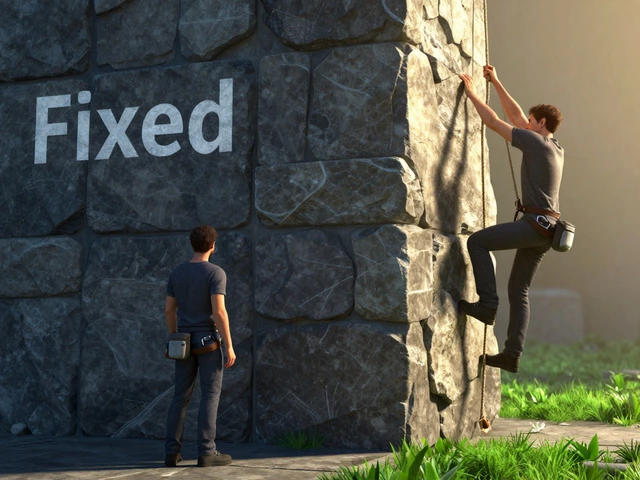
Mindset Reframe Challenge
Test your awareness of fixed vs. growth mindset language. Read the situation below, choose the most constructive response, and see how well you can "rewire" the thought.
Loading scenario...
You know that feeling when you stare at a blank page, a complex spreadsheet, or a new software interface, and your brain immediately screams, "I'm just not good at this"? It’s a familiar trap. We often treat our abilities like they’re carved in stone-either you have the talent, or you don’t. But what if that voice is lying to you? What if your brain is actually built to change, adapt, and get better through effort, not just raw intelligence?
This isn't just positive thinking fluff. It's backed by decades of research into how our brains work. The difference between someone who hits a wall and quits versus someone who breaks through it usually comes down to one thing: their growth mindset. Unlike a fixed mindset, which believes traits are static, a growth mindset thrives on challenges and persists despite setbacks. If you want to stop feeling stuck and start actually improving your skills, career, or relationships, you need to understand how to rewire those automatic thoughts. Here is how you can practically cultivate a growth mindset, moving beyond theory into daily action.
The Science Behind Your Brain’s Plasticity
Before we talk about changing your attitude, let’s look at the hardware. Your brain isn't a fixed machine; it’s more like a muscle. This concept is known as neuroplasticity, the brain's ability to reorganize itself by forming new neural connections throughout life. When you practice a skill-whether it’s coding in Python, playing guitar, or negotiating a salary-your neurons fire together and wire together. Over time, these pathways become stronger and faster.
A fixed mindset, conversely, assumes that intelligence and talent are static traits. People with this view often feel threatened by others' success because they see it as a reflection of their own inadequacy. They avoid challenges to protect their ego. In contrast, people with a growth mindset see effort as the path to mastery. They believe that while everyone starts with different baseline abilities, dedication and learning can significantly improve performance. This isn't about ignoring natural aptitude; it's about refusing to let it define your ceiling.
Identifying Your Fixed Mindset Triggers
You can't change what you don't notice. Most of us have a mix of both mindsets, but certain situations trigger our fixed-mindset voice. Do any of these sound familiar?
- Feedback Defense: When a boss or partner gives constructive criticism, do you immediately feel defensive or angry rather than curious?
- Comparison Trap: Do you scroll through LinkedIn or Instagram and feel inferior because someone else seems further ahead?
- Avoidance of Difficulty: Do you skip tasks that might make you look stupid or incompetent?
- Talent Worship: Do you assume successful people were just "born lucky" rather than having worked hard for years?
These triggers are your clues. For example, if you freeze up during public speaking because you fear judgment, that’s a fixed mindset signal. You’re prioritizing looking competent over becoming competent. Recognizing these moments is the first step to shifting gears. Keep a small note on your phone. Every time you catch yourself saying "I can't do this," write down the situation. After a week, you’ll likely see patterns.
Rewiring Your Internal Dialogue
Once you spot the triggers, you need to change the script. This isn't about forcing fake positivity. Saying "Everything is great!" when things are terrible feels dishonest and doesn't help. Instead, try reframing your thoughts using specific linguistic shifts. Psychologist Carol Dweck, the Stanford researcher who popularized the concept, emphasizes the power of language in shaping belief.
Here are some practical swaps:
| Fixed Mindset Thought | Growth Mindset Reframe |
|---|---|
| I'm not smart enough for this. | I can learn the skills I need with practice. |
| This is too hard. I give up. | This will take time and effort to master. |
| I made a mistake. I'm such an idiot. | Mistakes show me where I need to adjust my strategy. |
| They're so talented. I'll never be that good. | I wonder what strategies they used to get there. |
Notice the shift from identity ("I am") to process ("I can"). Identity statements are rigid. Process statements are flexible. When you tell yourself "I am bad at math," you close the door. When you say "I haven't mastered calculus yet," you leave it open. That little word "yet" is surprisingly powerful.

Embracing Failure as Data
In school, we were taught that failure is bad. You get a red mark, you lose points, you disappoint your parents. So we grew up fearing mistakes. But in the real world, especially in innovation and career growth, failure is just data. It tells you what didn't work so you can try something else.
Think about James Dyson, the inventor who created his famous vacuum cleaner after 5,127 failed prototypes. He didn't see those failures as proof he wasn't an inventor. He saw them as steps closer to the solution. To cultivate this, start conducting mini-experiments in your life. Try a new hobby you're terrible at. Cook a recipe you've never attempted. Ask for a raise and accept a "no" gracefully.
When things go wrong, ask three questions instead of beating yourself up:
- What exactly went wrong?
- What could I control in that situation?
- What will I do differently next time?
This turns emotional pain into actionable insight. It removes the shame associated with errors and replaces it with curiosity.
The Power of Process Praise
If you manage a team, teach children, or even coach yourself, pay attention to what you praise. Praising intelligence ("You're so smart!") tends to foster a fixed mindset. It makes people afraid to tackle harder problems because they don't want to lose their "smart" label. Praising effort and strategy ("I really liked how you broke that problem down") fosters a growth mindset.
This applies to self-talk too. Stop telling yourself you're "gifted." Start noticing your persistence. Did you stick with that difficult email draft for three hours? Did you research five different options before buying that laptop? Acknowledge the work. This reinforces the connection between effort and outcome. Over time, you begin to value the struggle itself because you associate it with progress, not just punishment.

Creating a Supportive Environment
Your environment shapes your mindset more than you think. If you surround yourself with people who only celebrate wins and mock losses, it’s hard to stay resilient. Seek out communities or colleagues who value learning. Join groups where beginners are welcome, not judged.
For instance, if you're learning a language, find a conversation partner who expects you to make grammar mistakes. If you're starting a business, find mentors who share their failures, not just their successes. Vulnerability breeds vulnerability. When someone admits, "I struggled with that project," it gives you permission to struggle too. This social support acts as a buffer against the inevitable dips in motivation.
Also, curate your media consumption. Unfollow accounts that make you feel inadequate. Follow creators who document their learning journey, showing the messy middle parts, not just the polished results. Seeing others struggle and succeed normalizes the process.
Sustaining the Shift Long-Term
Cultivating a growth mindset isn't a one-time switch you flip. It’s a practice. You will slip back into fixed mindset habits, especially when you're tired, stressed, or overwhelmed. That’s normal. The goal isn't perfection; it's awareness and redirection.
Set aside ten minutes each week to review your challenges. Look for moments where you avoided something due to fear. Plan a small step to address it next week. Maybe it’s signing up for a course, asking a colleague for feedback, or trying a new route to work. Small, consistent actions build confidence faster than grand gestures.
Remember, the brain changes slowly. Don't expect overnight transformation. Celebrate small wins. Did you handle criticism better today? Did you try a new task without complaining? These are victories. Over months and years, these small shifts compound into significant personal and professional growth. You aren't just changing your attitude; you're literally building a more capable, adaptable brain.
Is a growth mindset the same as positive thinking?
No, they are quite different. Positive thinking often involves ignoring negatives or pretending everything is fine. A growth mindset acknowledges difficulties and failures but views them as opportunities for learning and improvement. It requires realistic assessment and strategic effort, not just optimism.
Can anyone develop a growth mindset?
Yes, absolutely. Research shows that mindset is malleable. While some people may naturally lean toward one side, anyone can train their brain to adopt growth-oriented behaviors through conscious practice, reframing thoughts, and seeking challenges.
Does effort always lead to success?
Effort alone isn't magic. It must be paired with effective strategies and feedback. Blindly working hard without adjusting your approach won't yield results. A growth mindset encourages analyzing what works and what doesn't, then adapting your efforts accordingly.
How long does it take to change your mindset?
There is no set timeline. For some, noticeable shifts occur within weeks of deliberate practice. For others, it takes months or years. Consistency matters more than speed. The key is regular reflection and adjustment of your internal dialogue.
What if I fail despite having a growth mindset?
Failure still happens. The difference is how you interpret it. With a growth mindset, failure isn't a verdict on your worth; it's information. You analyze the causes, adjust your methods, and try again. Persistence combined with adaptation eventually leads to breakthroughs.