
Color Harmony Calculator
Test which colors work well together based on color theory. Select your base color and see compatible options. This tool is based on the color wheel principles discussed in our article.
Choose Your Base Color
Ever put on a shirt and pants that both looked fine on their own, but together? Like they were from different planets? You’re not alone. Most men struggle with matching clothes-not because they don’t care, but because no one ever taught them how to do it right.
Start with Color Theory, Not Guesswork
You don’t need to memorize Pantone codes, but you do need to understand the basics of how colors work together. Think of your wardrobe like a paint set: there are harmonious combinations, and there are clashes.Neutral colors-black, navy, gray, beige, and white-are your foundation. They don’t compete. They connect. A navy blazer works with gray trousers because they’re both cool tones. A beige shirt pairs with brown shoes because they’re both warm. Mix warm and cool tones without balance, and you look sloppy.
Try this: pick one neutral as your base, then add one color that’s either the same tone (monochrome) or opposite on the color wheel (complementary). Navy and mustard? That’s complementary. Black and charcoal? That’s monochrome. Both work. Navy and red? Also fine-red is bold, but navy holds it down. Red and green? Unless it’s Christmas, avoid it.
Pattern Mixing Is Easier Than You Think
Patterns scare people. Stripes, checks, plaids, dots-they feel like a minefield. But here’s the truth: you’ve worn patterned clothes all your life. Your dress shirt is probably striped. Your tie might be polka-dotted. The key isn’t avoiding patterns. It’s controlling them.Rule of thumb: mix one bold pattern with one subtle one. A pinstripe suit? Pair it with a solid color shirt and a silk tie with a small geometric print. A flannel shirt? Wear it open over a plain white tee with dark denim. The flannel brings the pattern, the tee and jeans bring calm.
Size matters. Big checks on a shirt? Don’t match them with wide stripes on a jacket. Too much visual noise. Instead, match a large plaid with a fine stripe or a solid. Texture helps too. A tweed jacket with a knit sweater underneath? That’s texture playing nice. Same color family, different surface. That’s how you look intentional, not random.
Fit Is the Silent Matchmaker
No matter how good your colors and patterns are, if your clothes don’t fit, they’ll ruin the look. A shirt that’s too tight or too loose throws off everything. Same with pants. Baggy jeans with a cropped jacket? That’s not streetwear. That’s a mistake.Here’s what works for most men in 2026: slim but not skin-tight. Shoulders should sit right at your natural shoulder line. Sleeves should end where your wrist bone starts. Pants should break once-just a slight fold at the top of your shoe. No bunching. No dragging.
Try this test: stand in front of a mirror and pull your shirt up slightly. If it wrinkles across your chest or pulls at the buttons, it’s too tight. If there’s a gap between your arm and the sleeve when you raise your hand, it’s too loose. Fit isn’t about fashion trends. It’s about respect-for yourself, and for the people you’re around.
Shoes and Socks Don’t Get a Pass
You can wear a perfectly matched outfit and still look off because of your shoes or socks. Shoes are the anchor. If they’re mismatched, the whole look sinks.Dark shoes (black, dark brown, oxblood) go with dark pants. Light shoes (tan, beige) go with light pants. Never wear black shoes with beige chinos. It’s a classic error. Brown shoes with navy? That’s fine. Black shoes with navy? Also fine. But brown with black? Avoid it unless you’re going for a very intentional, high-fashion look-and even then, it’s risky.
Socks? They’re not invisible. If you’re wearing shorts and loafers, wear no-show socks. If you’re wearing dress pants and oxfords, wear socks that match your pants, not your shoes. Navy socks with charcoal pants? Perfect. White socks with dark pants? That’s a look reserved for gym days, not dinner.
Layering Is Your Secret Weapon
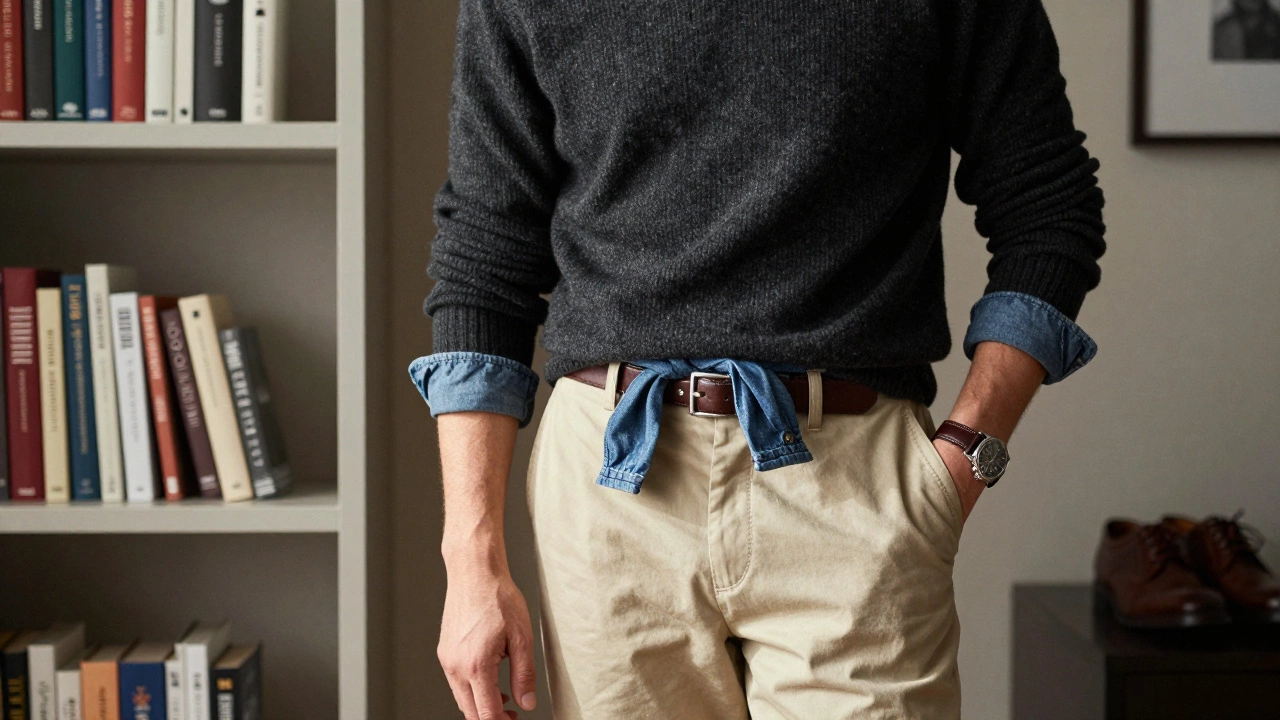
Layering isn’t just for winter. It’s for adding depth, texture, and dimension to any outfit. A simple T-shirt and jeans get a whole new life with a denim shirt tied at the waist, or a lightweight wool cardigan over it.Start with a base layer (T-shirt, henley), add a mid-layer (shirt, sweater), then finish with an outer layer (jacket, coat). Each layer should be slightly lighter in weight than the one before. A heavy wool coat over a thick hoodie? That’s bulky. A tailored blazer over a slim cotton shirt? That’s sharp.
Colors should flow. If your shirt is white, your sweater can be gray. Your coat can be navy. That’s a clean progression. If your shirt is green, your sweater is red, and your coat is brown? You’re not layered. You’re tangled.

Accessories Are the Final Touch
Belts, watches, hats, bags-they’re not afterthoughts. They’re the punctuation marks in your outfit. A belt should match your shoes. Not “sort of.” Match. Brown belt with brown shoes. Black belt with black shoes. No exceptions.Watches? Keep it simple. A leather strap with a dark suit. A metal bracelet with jeans and a denim shirt. Don’t wear a dive watch with a tuxedo. Don’t wear a gold dress watch with cargo pants. It’s not about price. It’s about context.
One rule: if you’re wearing more than one accessory, make sure they’re the same metal tone. Silver watch, silver bracelet, silver belt buckle? Good. Silver watch with a gold belt buckle? That’s a distraction.
Build a Capsule Wardrobe to Make It Easy
You don’t need 50 shirts and 20 pairs of pants. You need 8-10 pieces that work together. Here’s a starter set for any man in 2026:- 2 pairs of dark jeans (one slim, one straight)
- 1 pair of tailored navy trousers
- 1 pair of beige chinos
- 3 button-down shirts (white, light blue, gray)
- 2 knit sweaters (navy, charcoal)
- 1 navy blazer
- 1 dark brown leather belt
- 1 pair of black oxfords
- 1 pair of brown derbies
- 1 pair of white sneakers
That’s 13 items. But because they’re all neutral and well-fitting, you can mix and match them into over 50 outfits. No guesswork. No stress. Just pull something on and know it looks good.
Test Your Outfit Before You Leave
Before you walk out the door, do this: take a photo of yourself in natural light. Look at it. Does it look like you? Or like you’re trying too hard? Are the colors pulling together? Is anything fighting for attention? Is the fit right?That photo isn’t vanity. It’s feedback. Most men never see themselves the way others do. A quick snapshot helps you spot mismatches before you leave the house.
And if you’re still unsure? Stick to the basics. Navy shirt, gray pants, brown shoes, white socks. It’s not exciting. But it’s never wrong.
Can I wear brown shoes with black pants?
Yes, but only if the black pants are not part of a formal suit. For casual or smart-casual outfits, dark brown shoes with black jeans or black chinos work fine. But never with a black suit-that’s a rule. Formal black means black shoes. No exceptions.
What if I only have one pair of jeans?
You can still match outfits. Dark denim is incredibly versatile. Pair it with a navy sweater and white sneakers for a clean look. Add a gray jacket and brown loafers for something smarter. The key isn’t quantity-it’s knowing how to combine what you have. One good pair of jeans, three shirts, and a jacket can cover 90% of your weekly needs.
Do I need to match my belt and shoes exactly?
For formal or smart-casual settings, yes. A brown belt with black shoes looks careless. For casual wear, it’s less strict-but still better to match. If you’re wearing jeans and boots, and your belt is a different shade of brown, that’s fine. But if your belt is bright red and your shoes are charcoal? That’s a problem.
How do I know if my shirt is too big?
Try this: raise your arms. If the shirt pulls tight across your back or the sleeves ride up, it’s too tight. If you can pinch more than an inch of fabric at your side, it’s too loose. A well-fitting shirt should follow your body without hugging or hanging. The collar should lie flat, and the buttons shouldn’t strain when fastened.
Is it okay to wear patterned socks?
Only if the rest of your outfit is simple. A subtle striped or dotted sock can add personality under a suit or chinos. But avoid loud patterns like cartoon characters or neon stripes. They’re not fun-they’re distracting. Keep it classy: thin stripes, small dots, or tonal textures.
If you want to look put together without spending hours in front of the mirror, start with fit, then color, then pattern. The rest follows. You don’t need to be a fashion expert. You just need to be consistent.