

Commercial Mindset Calculator
Your Business Metrics
Analysis Results
Enter your data to see if you are operating with a commercial mindset.
You have a brilliant idea. You built the product. The quality is undeniable. So why isn’t anyone buying it? This is the classic trap for creators who lack a commercial mindset. It’s not just about being "business-minded" or loving money. It is a specific way of processing information, making decisions, and viewing the world through the lens of value exchange.
Most people think in terms of inputs: time spent, effort exerted, features added. A commercial mind thinks in terms of outputs: revenue generated, problems solved, margins protected. If you want to turn your skills into a sustainable career or business, you need to rewire how you approach work. Here is what that actually looks like in practice.
The Core Difference: Creator vs. Merchant
To understand the shift, we have to look at two distinct archetypes. The creator asks, "Is this good?" The merchant asks, "Will this sell?" Neither question is wrong on its own, but relying solely on one leads to failure. Artists often starve because they ignore market demand. Salespeople often burn out selling products nobody wants. A commercial mindset bridges this gap by asking both questions simultaneously.
This isn't about becoming cold or calculating. It’s about respecting the reality that without an exchange of value (money for goods/services), no enterprise survives. When you adopt this view, every decision-from hiring staff to choosing a font color-gets filtered through one metric: does this move the needle on our financial health?
The Four Pillars of Commercial Thinking
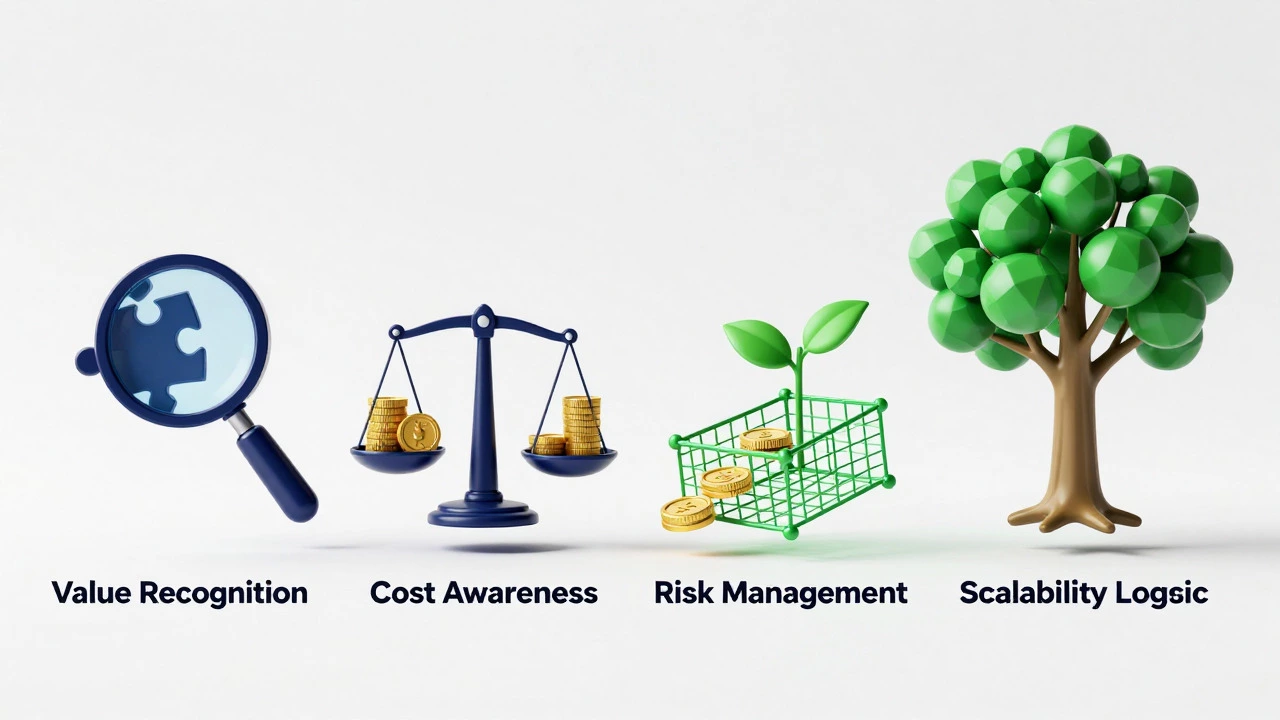
If you strip away the jargon, a commercial mindset rests on four practical pillars. Mastering these doesn't require an MBA; it requires attention to detail and a willingness to face hard truths.
- Value Recognition: Can you spot a problem people are willing to pay to solve? Most businesses fail here because they fall in love with a solution before validating the pain point. A commercial thinker spends weeks talking to customers before writing a single line of code or buying inventory.
- Cost Awareness: Everything has a price tag, including your time. If you spend ten hours designing a logo for free, you aren't being generous; you're subsidizing someone else's business. A commercial mind calculates the opportunity cost of every action. Is this task generating revenue, or is it just busy work?
- Risk Management: Business is probability management. Instead of avoiding risk entirely, a commercial thinker minimizes downside while keeping upside open. They use pre-sales, minimum viable products (MVPs), and small test markets to validate ideas before going all-in.
- Scalability Logic: Does this model grow linearly or exponentially? Trading hours for dollars is a cap on your income. A commercial mindset seeks leverage-using technology, teams, or capital to decouple time from earnings.
How to Spot a Lack of Commercial Acumen
It’s easy to criticize others, so let’s look inward. Do any of these habits sound familiar?
- Ignoring Unit Economics: You celebrate a sale without knowing if it was profitable after accounting for ads, shipping, and payment processing fees. Revenue is vanity; profit is sanity.
- Feature Creep: You keep adding bells and whistles because you think more is better. In reality, complexity kills conversion rates. Customers buy simplicity.
- Pricing Guilt: You undercharge because you’re afraid of losing clients. This attracts bad customers and devalues your expertise. High prices filter for serious buyers.
- Reaction Over Strategy: You put out fires all day instead of building systems. A commercial thinker automates or delegates repetitive tasks to focus on high-leverage activities.
If you nodded along to even one of these, don’t panic. These are common traps. The fix is to start tracking data ruthlessly. What gets measured gets managed.
Practical Exercises to Build Your Business Brain
You can train your brain to see commercial opportunities everywhere. Try these three exercises next week:
1. The "Why Would They Pay?" Audit Take your current project or job. Write down exactly what value you provide. Now, ask yourself: if I stopped tomorrow, would my client/customer feel immediate pain? If the answer is no, your offering is likely commoditized. Find the unique angle that makes you indispensable.
2. Reverse Engineer Competitors Pick three successful competitors. Don’t just look at their products; look at their marketing funnels. How do they get leads? What are their pricing tiers? Why did they choose those specific packages? Understanding their strategy reveals gaps you can exploit.
3. Calculate Your Hourly Rate Reality Add up your monthly business expenses and desired salary. Divide by the number of billable hours you actually work (not total hours). If the number is lower than you thought, you either need to raise prices, cut costs, or increase efficiency. This shock to the system forces commercial clarity.
| Decision Point | Creative Approach | Commercial Approach |
|---|---|---|
| Pricing | Based on perceived effort | Based on customer willingness to pay |
| Product Features | Add everything possible | Remove friction; add only high-value items |
| Marketing | "Build it and they will come" | Test channels; optimize for ROI |
| Failure | Personal rejection | Data point for iteration |
The Role of Emotional Intelligence in Business
A myth persists that commercial thinkers are robots. Nothing could be further from the truth. Selling is fundamentally about empathy. To make money, you must understand what keeps your customer awake at night. You must listen more than you talk. You must negotiate win-win outcomes where both parties feel respected.
Consider the difference between a pushy salesman and a trusted advisor. The former uses pressure tactics; the latter uses insight. A true commercial mindset leverages emotional intelligence to build long-term relationships, which lead to repeat business and referrals-the cheapest and most effective marketing available.

Common Pitfalls to Avoid
As you develop this mindset, watch out for these traps:
- Short-Termism: Sacrificing brand reputation for quick cash. One bad review can cost you more than a discount ever earned you.
- Analysis Paralysis: Waiting for perfect data. In business, speed often beats precision. Launch, learn, iterate.
- Ignoring Cash Flow: Profit is theoretical until the cash hits the bank. Many profitable businesses go bankrupt because they ran out of liquidity. Manage your cash cycle aggressively.
Next Steps for Implementation
Start small. Pick one area of your work this month to apply a commercial filter. Maybe it’s renegotiating a contract, auditing your software subscriptions, or testing a higher price point with five new prospects. Track the results. Adjust based on feedback. The goal isn’t perfection; it’s progress toward sustainability.
Remember, a commercial mindset isn’t about greed. It’s about freedom. When you master the mechanics of value creation and capture, you gain the autonomy to pursue projects that matter to you, hire talented people, and build something that lasts beyond your daily grind.
Can introverts have a commercial mindset?
Absolutely. A commercial mindset is about logic, strategy, and value assessment, not extroversion. Many successful entrepreneurs are introverts who prefer deep work and written communication over networking events. They excel at analyzing data and building scalable systems rather than relying on charisma alone.
How do I balance creativity with commercial needs?
Use the "80/20 rule." Spend 80% of your energy on proven, commercially viable solutions and 20% on experimental, creative risks. Ensure your core business generates stable cash flow to fund your creative explorations. Never let untested creativity jeopardize your livelihood.
What is the biggest mistake beginners make?
Falling in love with the product instead of the customer's problem. Beginners often spend months perfecting a solution nobody asked for. Always validate demand first by getting pre-orders or letters of intent before investing heavily in development.
Does a commercial mindset mean cutting corners?
No. Cutting corners destroys trust and leads to churn. A commercial mindset focuses on efficiency and smart resource allocation. It means finding cheaper ways to deliver the same high quality, or charging more for superior quality, not delivering inferior goods.
How long does it take to develop this mindset?
It varies, but noticeable shifts happen within 3-6 months of conscious practice. Start by reading financial statements, tracking your personal P&L, and studying case studies of businesses that failed due to poor unit economics. Experience accelerates learning significantly.